


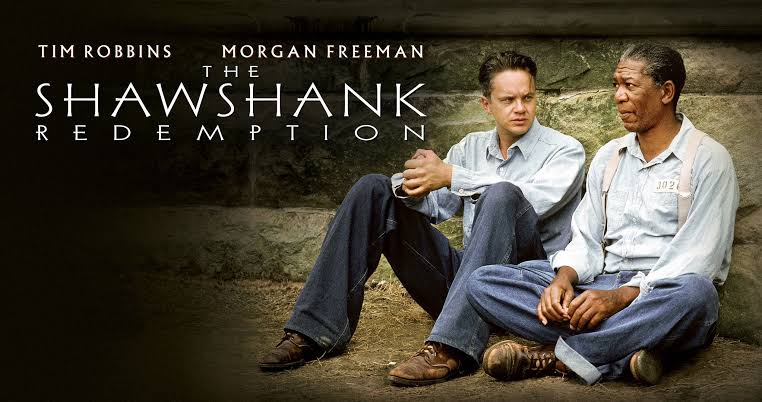
The Shawshank Redemption is a 1994 American drama directed and written by Frank Darabont. Based on Stephen King’s novella Rita Hayworth and Shawshank Redemption, the movie follows banker Andy Dufresne after he is sentenced to life in Shawshank State Penitentiary. Inside prison, Andy forms a lasting friendship with fellow inmate Ellis Boyd “Red” Redding while trying to hold on to hope, dignity, and a sense of purpose.
Tim Robbins plays Andy Dufresne, while Morgan Freeman plays Red. The supporting cast includes Bob Gunton, William Sadler, Clancy Brown, Gil Bellows, Mark Rolston, and James Whitmore. The American Film Institute lists Castle Rock Entertainment as the production company, Columbia Pictures as the distributor, and Niki Marvin as producer.
Although its first theatrical run was not a major commercial success, the movie slowly became one of the most respected American films of its period. It received seven Academy Award nominations and was later selected for preservation in the United States National Film Registry.
The Shawshank Redemption Wach Now Free
| Movie Detail | Information |
|---|---|
| Movie Title | The Shawshank Redemption |
| Release Year | 1994 |
| Country | United States |
| Main Genre | Drama |
| Director | Frank Darabont |
| Writer | Frank Darabont |
| Source Material | Rita Hayworth and Shawshank Redemption by Stephen King |
| Producer | Niki Marvin |
| Main Stars | Tim Robbins, Morgan Freeman |
| Production Company | Castle Rock Entertainment |
| Distributor | Columbia Pictures |
| Runtime | 142 minutes |
| Original Language | English |
| Estimated Budget | About $25 million |
| Rating | R in the United States |
About The Shawshank Redemption
At its heart, The Shawshank Redemption is a character-driven prison drama rather than a traditional crime movie. Prison provides the setting, but the main story is about friendship, patience, institutional life, injustice, fear, personal freedom, and the ability to keep believing that life can improve.
Andy Dufresne begins the story as a successful banker accused of murdering his wife and her lover. He maintains his innocence, but he is convicted and sent to Shawshank State Penitentiary. Prison life places him inside a system where routine, authority, fear, and corruption have enormous control over the people living there.
Andy gradually develops a friendship with Red, an experienced inmate who knows how prison society works. Their personalities are quite different. Andy is quiet, private, and patient, while Red is practical and socially connected. That difference helps make their friendship one of the strongest parts of the film.
The movie does not depend on constant action. Much of its power comes from conversations, small decisions, passing years, personal relationships, and the way characters respond to long periods of confinement.
The American Film Institute catalog provides detailed production and cast information for the film and confirms Frank Darabont as director and screenwriter.
Main ideas behind the story include:
- Hope during extremely difficult circumstances
- Friendship built over many years
- The psychological effects of institutional life
- Corruption and misuse of authority
- Education and knowledge as sources of personal strength
- The difference between physical freedom and mental freedom
- Patience and long-term planning
- Adjusting to life after years of confinement
When Was The Shawshank Redemption Released?
The Shawshank Redemption reached American theaters in 1994. Box Office Mojo records September 23, 1994 as its earliest domestic theatrical release date, followed by a wider release beginning October 14.
The release came during a particularly strong year for American movies. Other major 1994 films included Forrest Gump, Pulp Fiction, The Lion King, and Quiz Show. That level of competition is useful when looking at why The Shawshank Redemption did not immediately become a huge theatrical hit.
Its reputation grew after the original cinema period, helped by awards attention, home-video viewing, television broadcasts, and word of mouth.
| Release Detail | Information |
|---|---|
| Release Year | 1994 |
| Early U.S. Release | September 23, 1994 |
| Wider U.S. Release | October 14, 1994 |
| Original Distributor | Columbia Pictures |
| Country of Origin | United States |
| Runtime | 2 hours 22 minutes |
Movie Category And Genre
The main category of The Shawshank Redemption is drama. It also contains elements commonly associated with prison films, crime stories, friendship dramas, and period stories.
It should not be viewed mainly as an action movie. The film uses a slower storytelling style and gives characters enough time to develop across many years.
That approach makes the emotional changes more important than physical action. The audience watches how prison affects Andy, Red, Brooks, Tommy, Warden Norton, and the other people around them.
Suitable movie categories include:
- Drama
- Prison drama
- Crime drama
- Friendship drama
- Period drama
- Literary adaptation
- Character-focused movie
The film contains mature material involving prison violence, abuse, corruption, crime, and serious emotional themes, so parents may want to check its rating information before choosing it for younger viewers.
The Story Without Giving Away The Ending
Andy Dufresne enters Shawshank after being convicted of murder. He arrives with little understanding of prison life and initially keeps himself separate from many inmates.
Over time, he becomes close to Red, a prisoner known for obtaining items for other inmates. Andy’s banking knowledge later becomes useful inside the prison. His financial skills change his relationship with guards and prison officials, while his interest in books and education gives him another way to improve daily life inside Shawshank.
The story takes place across a long period. Instead of treating prison as a short chapter, the movie shows how years can change a person’s expectations, habits, friendships, and understanding of freedom.
Brooks Hatlen provides one of the film’s clearest examples of institutional dependence. After spending a very long time inside prison, ordinary life outside no longer feels simple. His storyline helps the movie ask a difficult question: what happens when a restrictive environment becomes the only environment a person truly knows?
Andy takes a different approach. He repeatedly looks for small ways to create purpose, whether through work, education, music, books, or friendship.
Important story elements include:
- Andy adjusting to prison
- His friendship with Red
- The prison library
- Financial work for prison officials
- Conflict with Warden Norton
- New inmates bringing unexpected information
- The effect of long imprisonment on different characters
- Andy’s continuing belief in a life beyond prison
Main Cast And Characters
The cast is one of the strongest parts of The Shawshank Redemption. Tim Robbins and Morgan Freeman lead the movie, but several supporting characters play major roles in showing different sides of prison life.
AFI credits Tim Robbins as Andy Dufresne, Morgan Freeman as Ellis Boyd “Red” Redding, Bob Gunton as Warden Samuel Norton, William Sadler as Heywood, Clancy Brown as Captain Byron Hadley, Gil Bellows as Tommy, Mark Rolston as Bogs Diamond, and James Whitmore as Brooks Hatlen.
| Actor | Character | Role In The Story |
|---|---|---|
| Tim Robbins | Andy Dufresne | Banker sentenced to life in Shawshank |
| Morgan Freeman | Ellis Boyd “Red” Redding | Andy’s closest prison friend |
| Bob Gunton | Warden Samuel Norton | Head of Shawshank prison |
| William Sadler | Heywood | Member of Red’s prison circle |
| Clancy Brown | Captain Byron Hadley | Senior prison guard |
| Gil Bellows | Tommy | Younger inmate who becomes important to Andy |
| Mark Rolston | Bogs Diamond | Prison inmate and antagonist |
| James Whitmore | Brooks Hatlen | Elderly prisoner who works in the library |
Tim Robbins As Andy Dufresne
Tim Robbins plays Andy with controlled emotion rather than making the character constantly explain how he feels. Andy often watches, listens, and thinks before acting.
That performance fits the structure of the movie because viewers gradually learn about Andy in much the same way Red does.
Andy is shown as:
- Intelligent
- Patient
- Private
- Educated
- Financially skilled
- Persistent
- Difficult for other prisoners to fully understand
Morgan Freeman As Red
Morgan Freeman’s Red acts as both an important character and the movie’s narrator.
Red understands Shawshank because he has spent many years there. His friendship with Andy slowly changes the way he thinks about hope and the possibility of another kind of life.
Freeman received an Academy Award nomination for Actor in a Leading Role for the performance.
Red’s role adds:
- Narration
- Experience
- Humor
- Emotional balance
- Practical knowledge of prison
- A different view of hope and freedom
Production Behind The Movie
Castle Rock Entertainment produced The Shawshank Redemption, with Columbia Pictures handling distribution. Niki Marvin served as producer, Frank Darabont directed and wrote the screenplay, Roger Deakins handled cinematography, Richard Francis-Bruce edited the movie, Terence Marsh worked as production designer, and Thomas Newman composed the music.
The creative team is important because the movie depends heavily on atmosphere. The prison has to feel restrictive and repetitive while the photography still gives important moments a sense of scale and emotional movement.
The British Film Institute also records Darabont as director and writer, Niki Marvin as producer, and the running time as 142 minutes. Readers looking for institutional film information can consult the British Film Institute film record.
| Production Role | Person Or Company |
|---|---|
| Director | Frank Darabont |
| Screenwriter | Frank Darabont |
| Producer | Niki Marvin |
| Cinematographer | Roger Deakins |
| Editor | Richard Francis-Bruce |
| Production Designer | Terence Marsh |
| Music | Thomas Newman |
| Production Company | Castle Rock Entertainment |
| Distributor | Columbia Pictures |
The Stephen King Story Behind The Film
The movie is adapted from Stephen King’s novella Rita Hayworth and Shawshank Redemption.
This source may surprise people who mainly connect Stephen King with horror. The Shawshank story is much more focused on crime, imprisonment, friendship, time, and personal hope.
Darabont adapted the novella into a feature screenplay while keeping the central relationship between Andy and Red at the center of the film.
The adaptation works because it allows the story to cover many years without making every year equally important. Major events are separated by periods in which prison routines continue, helping viewers understand how slowly time passes for long-term inmates.
The adaptation retains key elements such as:
- Andy Dufresne
- Red
- Shawshank prison
- The library
- Institutional life
- Financial knowledge
- The long passage of time
- The central idea of hope
Budget Of The Shawshank Redemption
The film had an estimated production budget of approximately $25 million, according to Box Office Mojo.
A $25 million budget was significant for a character-focused drama, particularly because the movie did not depend on large action sequences or visual effects. Much of that production had to create a convincing historical prison environment across several decades.
| Financial Detail | Approximate Amount |
|---|---|
| Production Budget | $25 million |
| Domestic Lifetime Gross | About $28.8 million |
| Original Opening | About $727,000 |
| Opening Theater Count | 33 theaters |
These figures also show why describing the movie simply as an immediate box-office success would be misleading. Its domestic lifetime gross was only moderately higher than its reported production budget, and cinema revenue is not the same thing as studio profit.
Marketing costs, distribution expenses, and the share of ticket sales retained by theaters also matter when evaluating financial performance.
Movie Revenue And Box Office Performance
Box Office Mojo currently lists a domestic lifetime gross of approximately $28.77 million across its recorded U.S. releases. Individual worldwide totals can differ slightly depending on which re-releases and territories are counted.
For readers checking financial data, the Box Office Mojo record provides territory and release information.
The more interesting part of the film’s financial history is that theatrical ticket sales tell only part of its story. Its reputation grew strongly after cinemas through home viewing, television, recommendations, and repeat audiences.
What its box-office history teaches us:
- A movie can have a modest theatrical start and still become culturally important.
- Opening-weekend figures do not always predict long-term reputation.
- Awards attention can introduce a film to people who missed it initially.
- Home viewing can significantly extend a movie’s audience.
- Critical and cultural value cannot be measured only through ticket revenue.
This makes The Shawshank Redemption a useful example of the difference between immediate commercial performance and long-term audience value.
Language And Runtime
The original language of The Shawshank Redemption is English, and the film was made in the United States.
Its running time is 142 minutes, or 2 hours and 22 minutes, according to the British Film Institute.
That length allows the story to cover many years without rushing major changes in Andy and Red’s friendship.
| Viewing Detail | Information |
|---|---|
| Original Language | English |
| Country | United States |
| Runtime | 142 minutes |
| Format | Feature film |
| Primary Genre | Drama |
Cinematography And Visual Style
Roger Deakins served as cinematographer, and his work received an Academy Award nomination.
Much of the visual storytelling depends on contrast. Prison interiors often feel enclosed and controlled, while moments involving the outside world tend to feel larger and less restricted.
The camera also gives the prison itself a strong presence. Shawshank is not simply a background location. Walls, corridors, cells, gates, offices, work areas, and the prison yard repeatedly remind viewers that the characters live within a highly controlled physical environment.
Visual elements worth noticing include:
- Large prison architecture
- Narrow cells and corridors
- Changes between indoor and outdoor space
- Lighting that reflects mood
- Repeated views of prison routines
- Careful framing of Andy and Red during conversations
Music And Sound
Thomas Newman composed the original score for the film. His work received an Academy Award nomination for Original Score.
The music is often restrained rather than overpowering conversations. This helps the emotional scenes feel connected to the characters instead of forcing the audience toward a particular reaction.
Sound is also important because prison is presented as a place filled with gates, footsteps, announcements, voices, doors, and repeated routines.
The soundtrack supports:
- Quiet reflective scenes
- Emotional changes
- Friendship
- Loneliness
- Hope
- Tension
- The contrast between confinement and freedom
Academy Award Nominations
The Shawshank Redemption received seven Academy Award nominations at the 67th Academy Awards. The movie did not win in those categories, but its nominations covered acting, writing, cinematography, editing, music, sound, and Best Picture.
The official Academy Awards record for 1995 confirms the seven nominations.
| Academy Award Category | Nominee |
|---|---|
| Best Picture | Niki Marvin |
| Actor in a Leading Role | Morgan Freeman |
| Adapted Screenplay | Frank Darabont |
| Cinematography | Roger Deakins |
| Film Editing | Richard Francis-Bruce |
| Original Score | Thomas Newman |
| Sound | Robert J. Litt, Elliot Tyson, Michael Herbick, Willie Burton |
The range of nominations is notable because it shows recognition across many parts of filmmaking rather than only one performance.
Why Hope Matters So Much In The Movie
Hope is the idea most commonly connected with The Shawshank Redemption, but the film does not present hope as simply wishing for something better.
Andy repeatedly connects hope with action. He works, reads, plans, teaches, writes letters, helps other prisoners, and tries to improve his surroundings.
Red initially takes a more cautious position. Years in prison have taught him to avoid expecting too much from the future.
That difference creates one of the film’s most meaningful conflicts. The two men care about each other but do not always agree about whether hope is useful or dangerous.
The film connects hope with:
- Patience
- Education
- Friendship
- Personal identity
- Planning
- Memory
- Freedom
- Refusing to let circumstances define everything about a person
Institutionalization And Brooks
Brooks Hatlen’s storyline adds another important layer to the movie.
After spending many years inside Shawshank, Brooks becomes accustomed to its rules and routines. The outside world changes while his own life remains structured by prison.
His experience shows that freedom can become frightening when a person has spent decades being told where to sleep, eat, work, and go.
This is one reason the film remains more thoughtful than a simple prison escape story. It asks what freedom actually means after someone has lost control over daily life for many years.
Brooks helps illustrate:
- Institutional dependence
- Fear of change
- Social isolation
- Aging
- Difficulty adjusting to a new environment
- The psychological cost of long imprisonment
Friendship Between Andy And Red
The relationship between Andy and Red gives the film its emotional center.
Their friendship develops slowly. There is no single moment where they suddenly become best friends. Instead, trust develops through years of conversations, favors, shared experiences, disagreements, and ordinary time together.
Andy gives Red a reason to reconsider some of his assumptions. Red gives Andy something equally important: human connection inside a place designed around confinement.
Their friendship works because they offer each other different things:
- Red understands prison life.
- Andy brings new ideas.
- Red provides practical help.
- Andy challenges Red’s pessimism.
- Both respect each other’s intelligence.
- Their relationship grows naturally over time.
The Movie’s Long-Term Cultural Importance
The reputation of The Shawshank Redemption became far larger than its original theatrical performance might have suggested.
The American Film Institute later ranked the film at No. 72 on its 10th anniversary edition of 100 Years…100 Movies.
In 2015, the Library of Congress selected The Shawshank Redemption for the National Film Registry. The registry preserves films considered culturally, historically, or aesthetically important to American film heritage. The official National Film Registry listing records the movie as a 1994 film inducted in 2015.
| Legacy Detail | Information |
|---|---|
| AFI Recognition | No. 72 on AFI’s anniversary list |
| Academy Award Nominations | 7 |
| National Film Registry | Added in 2015 |
| Original Release | 1994 |
| Long-Term Reputation | Major American drama classic |
What Makes The Shawshank Redemption Different From Many Prison Movies
The film uses prison as a setting but does not make prison violence its main attraction.
Its most memorable material is usually connected with character decisions, friendship, education, corruption, time, and the idea of continuing to think about a future even when circumstances seem permanent.
The long timeline also changes the viewing experience. Instead of watching one crisis over a few days, viewers see relationships develop across years.
Key differences include:
- Friendship is more important than action.
- Time itself becomes part of the story.
- Supporting characters have meaningful personal arcs.
- Education and knowledge play major roles.
- The film studies institutional life.
- The story balances sadness with hope.
- Small actions can have consequences many years later.
Who May Like This Movie?
The Shawshank Redemption may appeal most to viewers who enjoy stories where characters and relationships matter more than fast action.
Its long runtime and patient pace make it better suited to viewers comfortable with slower drama.
Because it contains mature prison themes, violence, abuse, strong language, and other adult material, its age rating should be considered before viewing.
It may suit viewers interested in:
- Serious drama
- Character-focused movies
- Prison stories
- Friendship stories
- Stephen King adaptations
- Morgan Freeman films
- Tim Robbins films
- Frank Darabont’s work
- Classic American cinema
- Stories about hope and resilience
Final Movie Details
More than three decades after its 1994 release, The Shawshank Redemption remains notable because its reputation was not created by a huge opening weekend.
It grew through audience recommendations, later viewing, awards recognition, and the strength of its central relationship between Andy and Red.
Its estimated $25 million budget and relatively modest original theatrical results also make its later cultural position unusual. The film moved from being a drama with limited early commercial impact to receiving recognition from institutions including the American Film Institute, the Academy of Motion Picture Arts and Sciences, and the Library of Congress.
For a viewer looking beyond the prison setting, the movie is really about what people do with time, how systems can change people, why friendship matters during difficult periods, and whether someone can maintain an inner sense of freedom when the outside world is beyond their control.
| Final Information | Details |
|---|---|
| Full Title | The Shawshank Redemption |
| Year | 1994 |
| Director | Frank Darabont |
| Writer | Frank Darabont |
| Producer | Niki Marvin |
| Main Cast | Tim Robbins, Morgan Freeman |
| Genre | Drama |
| Runtime | 142 minutes |
| Language | English |
| Production Company | Castle Rock Entertainment |
| Distributor | Columbia Pictures |
| Estimated Budget | $25 million |
| Domestic Lifetime Gross | About $28.8 million |
| Academy Award Nominations | 7 |
| National Film Registry | 2015 |