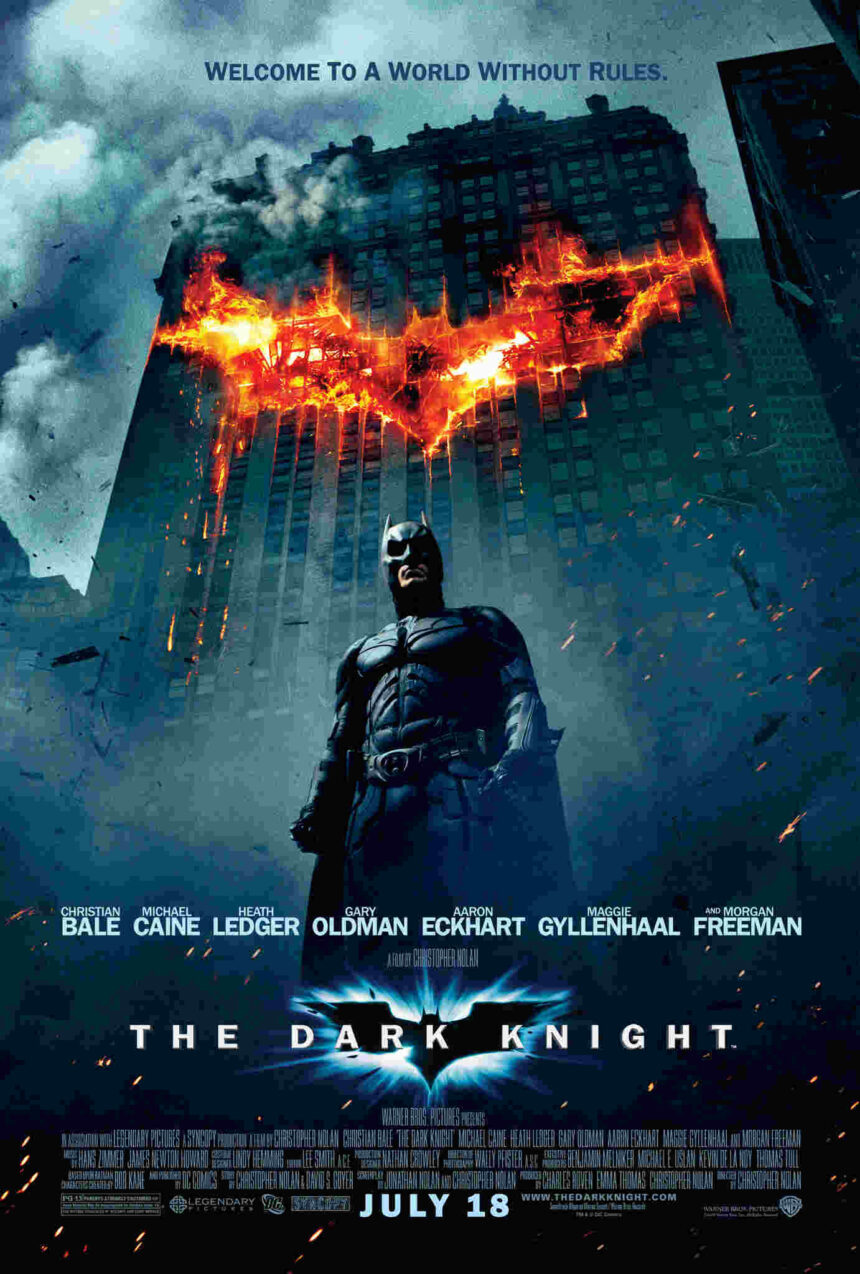
The Dark Knight is a 2008 American superhero crime thriller directed by Christopher Nolan. It is the second movie in Nolan’s Batman trilogy, following Batman Begins from 2005 and preceding The Dark Knight Rises from 2012. Christian Bale returns as Bruce Wayne and Batman, while Heath Ledger plays the Joker, Aaron Eckhart plays Harvey Dent, Gary Oldman plays Jim Gordon, Michael Caine plays Alfred Pennyworth, Maggie Gyllenhaal plays Rachel Dawes, and Morgan Freeman plays Lucius Fox.
Although Batman comes from comic books, The Dark Knight is structured much like a large crime thriller. The movie focuses on Gotham City’s fight against organized crime and what happens when the Joker begins attacking the systems Batman, Harvey Dent, and Jim Gordon are trying to protect. The British Film Institute record for The Dark Knight lists Christopher Nolan as director, Emma Thomas, Charles Roven, and Nolan as producers, and Christian Bale, Heath Ledger, and Aaron Eckhart among the featured cast.
| Movie Detail | Information |
|---|---|
| Movie Title | The Dark Knight |
| Release Year | 2008 |
| Director | Christopher Nolan |
| Main Writers | Jonathan Nolan and Christopher Nolan |
| Story | Christopher Nolan and David S. Goyer |
| Main Stars | Christian Bale, Heath Ledger, Aaron Eckhart |
| Main Genre | Crime Thriller, Superhero Drama |
| Country | United States |
| Original Language | English |
| Runtime | 152 minutes |
| U.S. Rating | PG-13 |
| Distributor | Warner Bros. Pictures |
| Estimated Budget | $185 million |
| Worldwide Box Office | About $1.008 billion across recorded releases |
About The Dark Knight
The story continues Bruce Wayne’s attempt to reduce crime in Gotham City while operating secretly as Batman. Bruce believes the city may finally have a public leader capable of fighting corruption without wearing a mask. That person is District Attorney Harvey Dent.
Harvey has become a strong public figure who is willing to challenge Gotham’s criminal organizations through the legal system. Batman and police officer Jim Gordon see him as an important part of a wider effort to change the city.
Their progress is interrupted by the arrival of the Joker. Unlike a traditional criminal who simply wants money or control, the Joker repeatedly creates situations designed to place people under pressure and force them into difficult moral choices.
That difference gives the film much of its tension. Batman is not simply trying to catch someone. He is dealing with someone who wants to damage the idea that Gotham can become better.
Major ideas in the movie include:
- Justice
- Crime and corruption
- Personal responsibility
- Fear
- Public trust
- Sacrifice
- Moral choices
- Leadership
- Identity
- Chaos and social order
The Dark Knight Release Date
The American Film Institute records July 18, 2008 as the film’s U.S. release date. Production had taken place from February 26 through November 11, 2007, with major filming in London and Chicago.
Box Office Mojo records the earliest international release as July 16, 2008 in Taiwan, with the major domestic opening taking place on July 18. The movie opened to approximately $158.4 million in the United States and Canada.
| Release Detail | Information |
|---|---|
| Main U.S. Release | July 18, 2008 |
| Earliest Recorded International Release | July 16, 2008 |
| Distributor | Warner Bros. Pictures |
| Runtime | 2 hours 32 minutes |
| U.S. Rating | PG-13 |
| Release Year | 2008 |
The film later returned to cinemas several times. Box Office Mojo records additional theatrical runs connected with 2012, 2018, 2020, 2021, 2022, 2023, 2024, and even a 2026 re-release in selected international markets.
Movie Category And Genre
The Dark Knight is often called a superhero movie because Batman and the Joker come from DC Comics, but its storytelling also fits the crime-thriller category very well.
Box Office Mojo classifies the film under crime and thriller, while the BFI describes it as Christopher Nolan’s second Batman film.
The story uses police investigations, organized crime, court cases, political pressure, corruption, surveillance, and criminal strategy alongside superhero elements.
| Category | How It Fits The Movie |
|---|---|
| Superhero | Batman is the central hero |
| Crime Thriller | Organized crime and investigations drive much of the plot |
| Action | Large chases and confrontations are included |
| Drama | Character choices have serious personal consequences |
| Comic Book Adaptation | Characters originate from DC Comics |
| Psychological Crime Story | The Joker tests Batman and Gotham through fear and pressure |
This mixture is one reason the movie can appeal to people who do not normally watch many superhero films. Its main conflict works even when viewed as a police and crime story.
The Story Without Giving Away The Ending
Gotham’s organized crime groups are losing money and influence because Batman, Jim Gordon, and Harvey Dent are placing increasing pressure on them.
At the same time, the Joker begins interfering with the city’s criminal world. He offers Gotham’s crime leaders a way to deal with Batman, but his methods quickly show that he is interested in more than a normal criminal agreement.
Bruce Wayne watches Harvey Dent’s rise carefully. Harvey can openly do something Batman cannot: represent lawful justice in public.
Bruce therefore begins considering whether Gotham may eventually reach a point where it no longer needs Batman.
The Joker challenges that hope by creating one crisis after another. His actions place Batman, Harvey, Gordon, Rachel, police officers, criminals, and ordinary citizens in situations where every decision can create another problem.
The main story focuses on:
- Batman’s campaign against organized crime
- Harvey Dent’s work as district attorney
- Jim Gordon’s police investigations
- The Joker’s attacks on Gotham
- Bruce Wayne’s relationship with Rachel
- Corruption inside city institutions
- Public opinion about Batman
- Difficult decisions involving justice and responsibility
The movie becomes increasingly personal as its characters are forced to decide what they are prepared to sacrifice.
Main Cast And Characters
AFI lists Christian Bale as Bruce Wayne and Batman, Heath Ledger as the Joker, Aaron Eckhart as Harvey Dent, Michael Caine as Alfred Pennyworth, Maggie Gyllenhaal as Rachel Dawes, Gary Oldman as Jim Gordon, Morgan Freeman as Lucius Fox, and Cillian Murphy as Scarecrow.
| Actor | Character |
|---|---|
| Christian Bale | Bruce Wayne / Batman |
| Heath Ledger | Joker |
| Aaron Eckhart | Harvey Dent |
| Michael Caine | Alfred Pennyworth |
| Maggie Gyllenhaal | Rachel Dawes |
| Gary Oldman | Jim Gordon |
| Morgan Freeman | Lucius Fox |
| Cillian Murphy | Scarecrow |
| Chin Han | Lau |
| Eric Roberts | Salvatore Maroni |
| Nestor Carbonell | Mayor Anthony Garcia |
The supporting cast matters because Gotham itself is presented as a network of police officers, government officials, business people, criminals, and ordinary residents rather than simply a background for Batman and the Joker.
Christian Bale As Bruce Wayne And Batman
Christian Bale returned to the role he first played in Batman Begins. Michael Caine, Gary Oldman, and Morgan Freeman also returned from the earlier movie.
Bruce faces a different problem in The Dark Knight. He has already become Batman, so the story does not need to explain how the identity was created.
Instead, Bruce starts asking what Batman is supposed to achieve in the long term.
If Gotham can build honest institutions and trusted public officials, remaining Batman forever may not be necessary.
That makes Harvey Dent especially important to Bruce.
Bruce Wayne’s main challenges include:
- Protecting Gotham
- Keeping his identity secret
- Supporting Harvey Dent
- Working with Jim Gordon
- Dealing with the Joker
- Protecting people close to him
- Deciding what Batman should represent
The movie therefore treats Batman as both a person and a symbol.
Heath Ledger As The Joker
Heath Ledger’s Joker became the film’s most celebrated performance.
The character is presented as unpredictable, highly observant, and focused on creating instability. His appearance is also different from earlier screen versions of the Joker. AFI notes that the makeup used a partly smudged design rather than the cleaner comic-style appearance seen in some previous versions.
Ledger died in January 2008, before the film’s theatrical release. The Dark Knight was dedicated in part to Ledger, as well as crew member Conway Wickliffe.
At the 81st Academy Awards, Ledger won the Oscar for Actor in a Supporting Role. His father Kim Ledger, mother Sally Bell, and sister Kate Ledger accepted the award on his behalf.
The Joker’s role in the movie centers on:
- Creating fear
- Testing people’s beliefs
- Challenging Batman
- Attacking public confidence
- Manipulating criminals and authorities
- Creating difficult choices
The character works as more than Batman’s physical opponent. He attacks the principles Batman is trying to protect.
Aaron Eckhart As Harvey Dent
Aaron Eckhart plays Harvey Dent, Gotham’s district attorney.
Harvey represents the legal path to changing Gotham. Batman operates outside ordinary law, while Harvey tries to fight crime through courts and public institutions.
That difference is important.
Bruce believes Harvey may become the hero Gotham can support openly. Gordon also sees value in Harvey’s campaign against organized crime.
Harvey Dent represents:
- Public leadership
- Legal justice
- Political courage
- Hope for Gotham
- The pressure placed on public figures
- The personal cost of fighting corruption
His position between Batman and Gotham’s official institutions makes him one of the movie’s most important characters.
Production Behind The Dark Knight
Christopher Nolan directed The Dark Knight. Jonathan Nolan and Christopher Nolan wrote the screenplay, while Christopher Nolan and David S. Goyer received story credit. Producers included Emma Thomas, Charles Roven, Christopher Nolan, and Thomas Tull.
Wally Pfister served as director of photography, Lee Smith edited the movie, and Nathan Crowley served as production designer.
| Production Role | Name |
|---|---|
| Director | Christopher Nolan |
| Screenplay | Jonathan Nolan, Christopher Nolan |
| Story | Christopher Nolan, David S. Goyer |
| Producers | Emma Thomas, Charles Roven, Christopher Nolan, Thomas Tull |
| Cinematography | Wally Pfister |
| Editing | Lee Smith |
| Production Design | Nathan Crowley |
| Distributor | Warner Bros. Pictures |
The production ran from February to November 2007 and used locations in the United States, United Kingdom, and Hong Kong.
Where Was The Dark Knight Filmed?
Chicago provided many of the streets, buildings, bridges, and city views used for Gotham.
According to AFI, filming also took place in London, Hong Kong, Cardington, and Pinewood Studios in England. Many interior scenes were completed at Pinewood and the large Cardington hangars.
Chicago locations included the Old Chicago Post Office, Navy Pier, and other downtown areas. The city’s recognizable bridges, elevated train lines, buildings, and waterways were often left visible rather than being heavily changed to hide Chicago’s identity.
| Filming Location | Production Use |
|---|---|
| Chicago | Major Gotham exteriors |
| Old Chicago Post Office | Opening bank sequence and other scenes |
| Navy Pier | Water and evacuation material |
| London | Production and location work |
| Pinewood Studios | Interior sets |
| Cardington, England | Large soundstage work |
| Hong Kong | International story sequence |
Using real urban locations gives Gotham a more grounded look than a city created entirely with digital environments.
The Dark Knight Budget
The reported production budget was approximately $185 million, according to Box Office Mojo.
That budget supported location filming in several countries, large practical sets, vehicles, stunt sequences, visual effects, a major cast, and large-format photography.
| Financial Detail | Approximate Figure |
|---|---|
| Production Budget | $185 million |
| Domestic Opening | $158.4 million |
| Original Domestic Gross | $533.3 million |
| Original Worldwide Gross | $1.0038 billion |
| Current Recorded Worldwide Total | About $1.0085 billion |
The opening weekend alone reached approximately $158.4 million domestically.
The Dark Knight Movie Revenue And Box Office
The Dark Knight became a major worldwide commercial success.
The current Box Office Mojo record for The Dark Knight lists approximately $534.99 million domestically, $473.30 million internationally, and $1.00848 billion worldwide across recorded theatrical releases.
The film’s original release alone generated approximately $1.0038 billion worldwide. Later re-releases added to that total.
| Box Office Area | Recorded Gross |
|---|---|
| Domestic | About $535 million |
| International | About $473.3 million |
| Worldwide | About $1.008 billion |
| Estimated Budget | $185 million |
These numbers represent theatrical ticket sales rather than studio profit. Cinemas retain part of ticket revenue, while marketing, distribution, production, and other costs also affect the final financial result.
Still, crossing the billion-dollar mark placed The Dark Knight among the major box-office successes of its period.
Language And Runtime
AFI records The Dark Knight as an English-language American production with a runtime of 152 minutes and a PG-13 rating.
The BFI also lists the running time as 152 minutes and identifies the production as a USA and United Kingdom film.
| Viewing Detail | Information |
|---|---|
| Main Language | English |
| Runtime | 152 minutes |
| U.S. Rating | PG-13 |
| Main Country | United States |
| Additional Production Country | United Kingdom |
| Release Year | 2008 |
The 152-minute runtime gives the story space for Batman, Joker, Harvey Dent, Gordon, Rachel, Alfred, and Lucius Fox to have separate roles within the same larger conflict.
IMAX And Cinematography
One of the movie’s most important technical choices was its use of IMAX cameras.
AFI states that The Dark Knight was the first major feature production to be at least partly photographed with IMAX cameras. Six sequences used the format, including the approximately six-minute opening bank sequence and parts of a major chase.
Wally Pfister handled the movie’s main cinematography and later received an Academy Award nomination for his work.
Important visual features include:
- Large city landscapes
- Nighttime street photography
- Practical vehicles and stunt work
- IMAX sequences
- Strong contrasts between public and private spaces
- Wide views of Gotham
- Detailed interior environments
The larger-format material helps some sequences feel physically bigger without making the entire movie depend on digital effects.
Music And Sound
Hans Zimmer and James Newton Howard created the film’s musical score, continuing their work from Batman Begins.
The music often separates Batman’s world from the Joker’s presence through very different sounds and rhythms.
Sound design was also one of the film’s most recognized technical areas.
At the Academy Awards, Richard King won Sound Editing for The Dark Knight.
The movie also received a nomination for Sound Mixing, recognizing Lora Hirschberg, Gary Rizzo, and Ed Novick.
Sound is important during:
- Vehicle chases
- Quiet confrontations
- Joker appearances
- Police operations
- Large city sequences
- Batman’s entrances
- Moments of rising tension
The Dark Knight Academy Awards
The Dark Knight received eight Academy Award nominations at the 81st Academy Awards and won two categories.
The official Academy Awards 2009 record confirms Heath Ledger’s Supporting Actor win and Richard King’s Sound Editing win.
| Academy Award Category | Result |
|---|---|
| Supporting Actor, Heath Ledger | Winner |
| Sound Editing, Richard King | Winner |
| Art Direction | Nominee |
| Cinematography | Nominee |
| Film Editing | Nominee |
| Makeup | Nominee |
| Sound Mixing | Nominee |
| Visual Effects | Nominee |
The nominations show that recognition was spread across acting, photography, editing, makeup, sound, visual effects, and production design rather than being limited to one area.
Why Harvey Dent Matters As Much As Batman And Joker
A useful way to understand The Dark Knight is to see Batman, Joker, and Harvey Dent as three different responses to Gotham.
Batman believes rules sometimes need an outside protector.
Harvey believes the legal system can still work if good people are willing to stand publicly behind it.
The Joker argues through his actions that rules and moral confidence can collapse when people are placed under enough pressure.
That triangle gives the story more depth than a simple hero-versus-villain setup.
The three positions can be understood as:
- Batman: justice from outside normal systems
- Harvey Dent: justice through public institutions
- Joker: deliberate rejection of order
This makes many of the film’s conflicts about ideas as well as physical action.
Why Gotham Feels Like A Real City
Gotham works particularly well in The Dark Knight because the production does not make every street look imaginary.
Chicago’s architecture remains visible throughout much of the film, while other scenes use London, Hong Kong, and studio environments.
This gives Gotham offices, courtrooms, streets, hospitals, warehouses, tunnels, high-rises, police stations, and public transport areas that feel connected to a functioning city.
The city therefore matters to the story.
Batman is not simply trying to stop one criminal. He is trying to protect public confidence in Gotham’s future.
Who May Like The Dark Knight?
The Dark Knight may appeal to viewers who enjoy superhero stories but also want crime, mystery, police investigation, character conflict, and serious moral questions.
The film is darker than many lighter superhero adventures and carries a PG-13 rating in the United States.
It may suit viewers interested in:
- Batman movies
- Superhero films
- Crime thrillers
- Christopher Nolan movies
- Christian Bale performances
- Heath Ledger performances
- Large-scale practical action
- Character-driven conflicts
- Police and organized-crime stories
- IMAX filmmaking
Because the movie contains violence, threats, disturbing situations, and mature themes, younger viewers should follow the film’s age classification and household viewing rules.
Final Movie Information
The Dark Knight was released in 2008 as the middle chapter of Christopher Nolan’s Batman trilogy. It brought back Christian Bale, Michael Caine, Gary Oldman, and Morgan Freeman from Batman Begins while introducing Heath Ledger’s Joker and Aaron Eckhart’s Harvey Dent.
Its production budget was approximately $185 million, and its original theatrical release crossed $1 billion worldwide. Later re-releases increased its recorded worldwide total to roughly $1.008 billion.
The film also received eight Academy Award nominations, winning Supporting Actor for Heath Ledger and Sound Editing for Richard King.
Beyond those numbers, the movie’s main strength is how it connects superhero action with questions about justice, public trust, leadership, fear, and the cost of protecting a city.
| Final Detail | Information |
|---|---|
| Full Title | The Dark Knight |
| Release Year | 2008 |
| Director | Christopher Nolan |
| Screenwriters | Jonathan Nolan, Christopher Nolan |
| Story | Christopher Nolan, David S. Goyer |
| Main Cast | Christian Bale, Heath Ledger, Aaron Eckhart |
| Genre | Crime Thriller, Superhero Drama |
| Runtime | 152 minutes |
| Language | English |
| U.S. Rating | PG-13 |
| Distributor | Warner Bros. Pictures |
| Estimated Budget | $185 million |
| Worldwide Box Office | About $1.008 billion |
| Academy Award Nominations | 8 |
| Academy Award Wins | 2 |
| Main Filming Areas | Chicago, London, Hong Kong |