


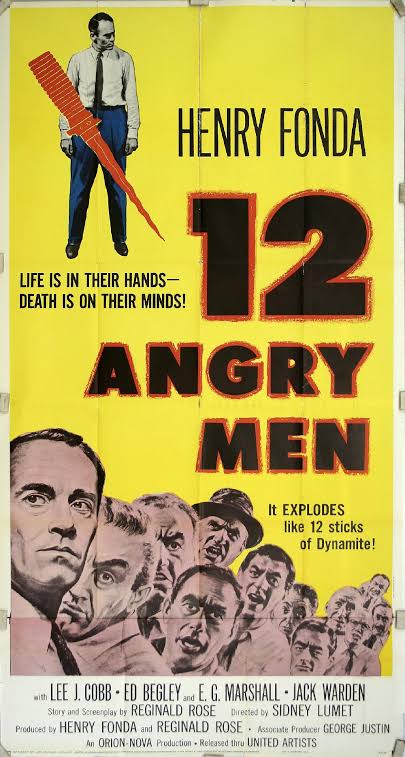
12 Angry Men is a 1957 American courtroom drama directed by Sidney Lumet in his feature-film directing debut. Written by Reginald Rose from his earlier television play, the movie follows twelve jurors who must decide whether a teenage defendant is guilty of murder. What first appears to be a quick decision becomes a tense discussion about evidence, reasonable doubt, personal bias, responsibility, and the danger of judging someone too quickly.
Henry Fonda leads the cast as Juror 8, the only member of the jury who initially refuses to vote guilty. Lee J. Cobb, Ed Begley, E. G. Marshall, Jack Warden, Martin Balsam, John Fiedler, Jack Klugman, Edward Binns, Joseph Sweeney, George Voskovec, and Robert Webber complete the main jury cast. The film runs for about 96 minutes and was released in the United States in April 1957.
| Movie Detail | Information |
|---|---|
| Movie Title | 12 Angry Men |
| Release Year | 1957 |
| Director | Sidney Lumet |
| Writer | Reginald Rose |
| Producers | Henry Fonda, Reginald Rose |
| Main Star | Henry Fonda |
| Genre | Courtroom Drama, Legal Drama |
| Country | United States |
| Language | English |
| Runtime | 96 minutes |
| Production Budget | About $340,000 |
| Distributor | United Artists |
| Production Company | Orion-Nova Productions |
| Academy Award Nominations | 3 |
| National Film Registry | Selected in 2007 |
About 12 Angry Men
12 Angry Men is built around a simple situation. A jury has listened to a murder trial and must decide whether the young defendant is guilty. Eleven jurors initially believe the case is clear. Juror 8 is not convinced enough to make an immediate decision.
He does not begin by claiming that the defendant is innocent. His main concern is that the evidence should be discussed carefully before the jurors make a decision with serious consequences.
That small disagreement changes the entire atmosphere of the room.
The British Film Institute describes the film as Sidney Lumet’s feature debut and highlights its focus on reason, prejudice, and jury-room pressure.
Main ideas behind the movie include:
- Reasonable doubt
- Justice
- Personal responsibility
- Group pressure
- Bias
- Prejudice
- Patience
- Listening
- Anger
- Social differences
- The importance of examining evidence carefully
12 Angry Men Release Information
12 Angry Men reached American theaters in April 1957. The Numbers lists April 10, 1957 as its domestic release date through United Artists, while Box Office Mojo records April 13 as its earliest domestic release date. Differences like this can happen when sources use separate premiere, city-opening, or wider-release dates.
The film was produced at a time when large historical productions and colorful widescreen movies were common attractions. 12 Angry Men took a very different approach. It relied mainly on one room, twelve actors, dialogue, camera placement, and gradually increasing tension.
| Release Detail | Information |
|---|---|
| Release Month | April 1957 |
| U.S. Release | April 1957 |
| Distributor | United Artists |
| Country | United States |
| Runtime | 96 minutes |
| Format | Black and White |
| Main Setting | Jury deliberation room |
Its modest original commercial performance did not prevent it from becoming much more respected over time. The film later became widely studied for its writing, acting, directing, and treatment of jury decision-making.
Movie Category And Genre
12 Angry Men is primarily a courtroom and legal drama, although very little of the film actually takes place inside the courtroom.
The courtroom case has already been heard when the main story begins. The real focus is jury deliberation.
The Numbers classifies the film as drama with a courtroom and legal subgenre, while Box Office Mojo places it within crime and drama.
| Category | How It Appears In The Film |
|---|---|
| Legal Drama | The story centers on a jury verdict |
| Courtroom Drama | Trial evidence drives the discussion |
| Crime Drama | A murder case forms the background |
| Character Drama | Each juror responds differently |
| Psychological Drama | Pressure changes how the men behave |
| Social Drama | Bias and class assumptions affect opinions |
The movie does not depend on constant physical action. Its tension comes from arguments, questions, changing opinions, and the way people react when their beliefs are challenged.
Story Of 12 Angry Men Without Major Ending Spoilers
The film begins after closing arguments in a murder trial. Twelve jurors enter a room where they must decide whether the defendant is guilty.
At first, the vote appears simple.
Eleven men vote guilty.
Juror 8 votes differently.
Instead of trying to prove a complete alternative version of the case, he asks whether the evidence is strong enough to justify an immediate decision.
That question forces the group to go back through important parts of the trial.
Witness statements are questioned. Timing is reconsidered. Assumptions are challenged. Some jurors begin separating what they actually know from what they simply assumed.
As the discussion continues, the film also shows that people do not enter a jury room without personal history. Their experiences with family, work, social class, age, and other people can affect how they interpret information.
The story mainly follows:
- The jury’s first vote
- Juror 8 asking for more discussion
- Questions about witness statements
- Different interpretations of evidence
- Personal disagreements between jurors
- Group pressure
- Changing votes
- The difference between certainty and reasonable doubt
The movie keeps the focus on the discussion rather than turning the case into a traditional mystery.
Main Cast And Characters
The cast is one of the strongest parts of 12 Angry Men. Instead of giving the jurors normal character names, the movie mostly identifies them by their jury numbers.
Henry Fonda plays Juror 8, while Lee J. Cobb plays Juror 3. The supporting cast includes experienced stage and screen actors who give each juror a different personality.
The BFI lists Henry Fonda, Lee J. Cobb, Ed Begley, E. G. Marshall, and Jack Warden among the principal cast. The Numbers provides the full lead ensemble.
| Actor | Character |
|---|---|
| Martin Balsam | Juror 1 |
| John Fiedler | Juror 2 |
| Lee J. Cobb | Juror 3 |
| E. G. Marshall | Juror 4 |
| Jack Klugman | Juror 5 |
| Edward Binns | Juror 6 |
| Jack Warden | Juror 7 |
| Henry Fonda | Juror 8 |
| Joseph Sweeney | Juror 9 |
| Ed Begley | Juror 10 |
| George Voskovec | Juror 11 |
| Robert Webber | Juror 12 |
The absence of regular character names helps keep attention on the jurors’ behavior and arguments rather than their personal identities outside the room.
Henry Fonda As Juror 8
Henry Fonda’s Juror 8 is the central figure in the film.
He is not shown as someone who knows every answer. Instead, his strongest quality is his willingness to ask questions.
He is calm when other jurors become impatient. He listens carefully and tries to keep the discussion connected to the evidence.
This approach makes him different from a traditional movie hero. He does not need physical action or dramatic speeches in every scene. His influence comes from patience and reasoning.
| Juror 8 Character Trait | How It Matters |
|---|---|
| Patient | He does not rush the decision |
| Observant | He notices details others overlook |
| Calm | He often responds without matching other people’s anger |
| Questioning | He asks whether assumptions are reliable |
| Independent | He is willing to disagree with the majority |
| Responsible | He treats the decision seriously |
Fonda also served as a producer on the film alongside writer Reginald Rose. The Academy later nominated both men as producers when the film competed for Best Motion Picture.
Lee J. Cobb As Juror 3
Lee J. Cobb gives one of the film’s most intense performances as Juror 3.
Juror 3 strongly believes in a guilty verdict and becomes increasingly frustrated as other jurors question the case.
His reactions are important because the movie gradually suggests that judgment is not always based only on evidence. A person’s private experiences can influence how strongly they respond to someone else.
The film uses Juror 3 to show how difficult it can be to separate personal anger from objective decision-making.
Juror 3 adds several important elements:
- Strong opposition to Juror 8
- Emotional tension
- Personal conflict
- Resistance to changing opinions
- Questions about objectivity
- A contrast with Juror 8’s calmer style
The relationship between Juror 3 and Juror 8 gives much of the movie its tension without requiring the story to leave the jury room.
Other Jurors And Why They Matter
The remaining jurors are not simply background characters.
Each represents a different personality and approach to responsibility.
Some want to study the evidence carefully. Others are impatient. One is primarily worried about leaving. Another brings personal prejudice into the discussion. Some change their minds quickly, while others require much more convincing.
| Juror | General Role In The Discussion |
|---|---|
| Juror 1 | Tries to maintain order as foreman |
| Juror 2 | Quiet and initially unsure |
| Juror 4 | Logical and focused on facts |
| Juror 5 | Brings knowledge from his background |
| Juror 6 | Practical and respectful |
| Juror 7 | Often impatient with the process |
| Juror 9 | Older and observant |
| Juror 10 | Allows prejudice to affect judgment |
| Juror 11 | Takes jury responsibility seriously |
| Juror 12 | Frequently uncertain and changeable |
This range of personalities allows the movie to show that group decisions can be affected by many factors besides the evidence itself.
Production Behind 12 Angry Men
12 Angry Men was Sidney Lumet’s first feature film as director.
Before making the movie, Lumet had already built substantial experience directing television. That background suited a story that depended heavily on actors, dialogue, precise timing, and a limited physical setting.
Reginald Rose wrote the screenplay from his own television play. Henry Fonda and Rose produced the film through Orion-Nova Productions, with United Artists handling distribution. The Numbers records the production budget at approximately $340,000.
| Production Role | Person Or Company |
|---|---|
| Director | Sidney Lumet |
| Screenwriter | Reginald Rose |
| Producers | Henry Fonda, Reginald Rose |
| Cinematography | Boris Kaufman |
| Editing | Carl Lerner |
| Music | Kenyon Hopkins |
| Production Company | Orion-Nova Productions |
| Distributor | United Artists |
| Budget | About $340,000 |
The production proves that a film does not need a huge number of locations to create tension. Careful performances and camera work can make one room feel very different as a story progresses.
From Television Play To Feature Film
The story existed before the 1957 movie.
Reginald Rose originally wrote Twelve Angry Men as a television drama. The earlier version was broadcast in 1954 as part of Studio One.
The feature film kept the same basic idea but gave the story more time and cinematic space.
The BFI notes that the film was adapted by Rose from his own teleplay.
| Adaptation Detail | Information |
|---|---|
| Original Form | Television play |
| Original Writer | Reginald Rose |
| Film Screenwriter | Reginald Rose |
| Feature Director | Sidney Lumet |
| Feature Release | 1957 |
| Main Setting | Jury room |
Turning the story into a movie gave Lumet more control over framing, camera distance, pacing, and the physical feeling of the room.
Cinematography And The Jury Room
Boris Kaufman served as cinematographer.
One of the most interesting parts of the film is how the room seems to change even though its basic physical size remains the same.
Early scenes often give the jurors more space in the frame. As tension increases, the visual style increasingly brings viewers closer to faces and reactions.
The BFI has specifically praised Lumet’s use of a single set and increasingly claustrophobic close-ups.
Visual techniques that support the story include:
- Close-ups during tense exchanges
- Careful placement of all twelve jurors
- Changes in camera distance
- Limited movement outside the room
- Black-and-white photography
- Attention to facial reactions
- Framing that makes the room feel increasingly restrictive
These choices help prevent the single location from becoming visually repetitive.
Runtime And Language
12 Angry Men runs for approximately 96 minutes.
Both the BFI and The Numbers list the movie at 96 minutes. The film is an American production and its original language is English.
| Viewing Detail | Information |
|---|---|
| Runtime | 96 minutes |
| Language | English |
| Country | United States |
| Release Year | 1957 |
| Format | Black and White |
| Production Method | Live Action |
The relatively short runtime works well because the story is focused. There are few side plots, and almost every major scene contributes directly to the jury discussion.
Budget Of 12 Angry Men
The reported production budget was approximately $340,000.
The Numbers currently lists the budget at $340,000.
Compared with large studio productions of its period, this was a modest film. The limited setting helped keep production needs focused on acting, set design, photography, sound, and rehearsal rather than expensive large-scale sequences.
| Financial Detail | Amount |
|---|---|
| Reported Production Budget | About $340,000 |
| Main Production Style | Single-set drama |
| Distributor | United Artists |
| Current Tracked Re-release Revenue | Limited data only |
A lower budget did not prevent the movie from gaining major awards recognition or long-term cultural importance.
12 Angry Men Movie Revenue And Box Office
The financial history of 12 Angry Men requires careful explanation because modern box-office databases do not preserve a complete domestic gross for its original 1957 theatrical run.
The financial record at The Numbers currently shows the original domestic box office as unavailable and tracks only a small amount from later international releases. Box Office Mojo likewise contains incomplete historical territory data rather than a full original worldwide total.
Because of that missing historical reporting, it would be misleading to compare the $340,000 production budget directly with the small modern re-release totals currently displayed by those databases.
| Revenue Detail | Information |
|---|---|
| Original Domestic Gross | Not fully available in modern databases |
| Production Budget | About $340,000 |
| Later International Revenue | Partially tracked |
| Box Office Mojo Tracked Worldwide Total | $13,168 across available recorded releases |
| The Numbers Tracked International Total | $3,111 in its current territory data |
The difference between the two tracked figures comes from the releases and territories each database currently includes. Neither number should be treated as the complete lifetime theatrical income of the film.
This is a good example of why older movie revenue needs more context than modern box-office reporting.
Academy Award Nominations
12 Angry Men received three Academy Award nominations at the 30th Academy Awards.
The official Academy Awards record confirms nominations for Sidney Lumet’s directing, Henry Fonda and Reginald Rose as producers of the Best Motion Picture nominee, and Reginald Rose’s adapted screenplay.
| Academy Award Category | Nominee |
|---|---|
| Best Motion Picture | Henry Fonda and Reginald Rose |
| Directing | Sidney Lumet |
| Adapted Screenplay | Reginald Rose |
The film did not win these Oscars. The Bridge on the River Kwai won Best Motion Picture, Directing, and the adapted screenplay category that year.
Even without an Oscar win, three nominations were significant recognition for a small, dialogue-heavy drama made by a first-time feature director.
National Film Registry Recognition
The movie’s long-term importance received another major acknowledgment in 2007, when it was selected for the United States National Film Registry.
The Library of Congress National Film Registry lists 12 Angry Men as a 1957 film selected in 2007. The Library explains that National Film Registry selections are made because films are considered culturally, historically, or aesthetically significant.
| Legacy Detail | Information |
|---|---|
| Film | 12 Angry Men |
| Original Year | 1957 |
| National Film Registry Selection | 2007 |
| Preservation Institution | Library of Congress |
| Reason For Registry Program | Cultural, historical, or aesthetic significance |
This later recognition shows how strongly the film’s standing grew beyond its original theatrical period.
Why Reasonable Doubt Is Central To The Movie
One of the most useful ways to understand 12 Angry Men is to notice that Juror 8 does not need to prove exactly what happened.
His question is narrower.
Is the evidence certain enough to justify a guilty verdict?
That distinction drives the entire story.
The film repeatedly shows jurors moving from statements such as “this must have happened” toward questions such as “could there be another reasonable explanation?”
The movie connects reasonable doubt with:
- Asking questions
- Checking assumptions
- Listening to other people
- Separating facts from personal feelings
- Reconsidering witness reliability
- Accepting that certainty has limits
- Taking responsibility seriously
This makes the film useful not only as courtroom entertainment but also as a story about critical thinking.
Group Pressure And Independent Thinking
The opening vote creates a clear majority against one person.
That situation makes Juror 8’s choice important even before any evidence is reconsidered.
Agreeing with eleven people would be easier than asking them to stay and talk.
The film then reverses the pressure gradually. As opinions change, different jurors find themselves in the minority.
| Group Behavior | Example In The Story |
|---|---|
| Majority pressure | Eleven jurors initially agree |
| Independent judgment | Juror 8 asks for discussion |
| Changing opinion | Jurors reconsider evidence |
| Emotional pressure | Arguments become personal |
| Social influence | Jurors react to one another |
| Critical thinking | Claims are checked rather than simply accepted |
The movie suggests that changing your mind after hearing better reasoning is not weakness. In some situations, it can show that you are paying attention.
Prejudice And Personal Bias
Another major part of the movie concerns the assumptions people bring into serious decisions.
Some jurors judge the defendant partly through ideas about where he comes from or the kind of person they assume he must be.
Others are influenced by private experiences that have little to do with the trial itself.
The story gradually separates these emotional reactions from evidence.
Examples of bias shown in the film include:
- Class assumptions
- Prejudice about background
- Family frustrations
- Personal anger
- Impatience
- Desire to leave quickly
- Confidence based on social status
- Refusal to reconsider an earlier opinion
This gives the movie a wider meaning beyond one fictional court case.
Why The Single-Room Setting Works
A film set almost entirely in one room might sound visually limited, but 12 Angry Men turns that limitation into an advantage.
Every movement becomes noticeable.
When someone stands up, moves toward a window, walks away from the table, or sits apart from the others, the change has meaning.
The room also feels increasingly uncomfortable as tempers rise.
| Single-Room Advantage | Effect |
|---|---|
| Limited exits | Characters must continue facing one another |
| Close camera work | Reactions become more noticeable |
| Small physical space | Tension feels stronger |
| Few distractions | Dialogue stays central |
| Shared table | Group relationships remain visible |
| Repeated setting | Small changes become meaningful |
The BFI specifically notes the film’s effective use of its single set and close-up photography.
Who May Like 12 Angry Men?
12 Angry Men may be a strong choice for viewers who prefer writing, performances, debate, and psychological tension over large action sequences.
The film is especially suited to people interested in law, jury systems, decision-making, classic cinema, or stories built around moral questions.
It may appeal to viewers who enjoy:
- Courtroom dramas
- Classic black-and-white films
- Strong dialogue
- Henry Fonda movies
- Sidney Lumet films
- Legal stories
- Character-based drama
- Psychological tension
- Group decision-making stories
- Movies about justice
Because the film focuses strongly on conversation, viewers who pay attention to small changes in wording and behavior may get the most from it.
What Makes 12 Angry Men Still Worth Discussing
The film was released in 1957, yet many of its questions remain easy to understand.
How certain should someone be before making a serious judgment?
Can a confident witness still be mistaken?
How much do personal experiences shape opinions?
Should someone change a decision when better reasoning appears?
What happens when a group values speed more than careful thought?
These questions give the movie value beyond its historical setting.
Its lasting strengths include:
- Clear central conflict
- Strong ensemble acting
- Focused screenplay
- Careful camera work
- Simple setting
- Moral uncertainty
- Memorable character differences
- A serious approach to responsibility
Its 2007 National Film Registry selection and its three Academy Award nominations support its lasting position within American film history.
Reviews
12 Angry Men shows how a film can build strong tension without a large budget, many locations, or complicated visual effects.
Sidney Lumet’s feature debut places twelve characters in a jury room and lets their opinions, personalities, assumptions, and disagreements move the story forward.
Henry Fonda’s Juror 8 provides the starting point by asking the group to take more time before reaching a final decision. From there, Reginald Rose’s screenplay turns one jury discussion into a wider examination of justice, bias, responsibility, and reasonable doubt.
The movie had a reported production budget of about $340,000 and a runtime of 96 minutes. Complete original 1957 box-office totals are not preserved in the major modern financial databases, so small re-release figures should not be mistaken for the movie’s complete historical revenue.
It received three Academy Award nominations and was selected for the National Film Registry in 2007.
| Final Detail | Information |
|---|---|
| Full Movie Name | 12 Angry Men |
| Release Year | 1957 |
| Director | Sidney Lumet |
| Writer | Reginald Rose |
| Producers | Henry Fonda, Reginald Rose |
| Lead Actor | Henry Fonda |
| Main Genre | Courtroom and Legal Drama |
| Runtime | 96 minutes |
| Language | English |
| Country | United States |
| Distributor | United Artists |
| Production Company | Orion-Nova Productions |
| Budget | About $340,000 |
| Original Box Office | Complete figure unavailable |
| Academy Award Nominations | 3 |
| National Film Registry | 2007 |